Author Archives: Jason

About Jason

Jason R. Koepke is Founder and Data Strategist at GNT LLC, a risk-analysis and data strategy firm that provides analytical and technical services to the public and private sectors. His work and research has been featured in the academic, financial, and technical industries.

Album Reviews

1—->3—>5
Terrible—>Fantastic

5
V/A – Music of Islam, Volumes 1-9

4
Black Angels, The – Directions to See a Ghost

3
Crystal Castles – Crystal Castles
DJ Surgeon – Ghetto Tech Mixin Phase 5
Gutterbreakz – Annex Audio, Process Part 096
Pash – Best Gun, The
Welch, Gillian – Revival

2
Be Your Own Pet – Get Awkward
Cyantific – Hospitalised 10 Years of Hospital [NHS100CD] (CD03)
DJ Slugo – Cardboard Booty
Èåïäïóéá Ôóáôóïõ – Best Of
Ghostface Killah – Ghostdeini The Great
High Contrast – Hospitalised 10 Years of Hospital [NHS100CD (CD02)
Kills, The – Run Home Slow EP

1
Beyonce – I Am…Sasha Fierce
Coheed and Cambria – Good Apollo, I’m Burning Star IV, Volume 01
Coheed and Cambria – Good Apollo, I’m Burning Star IV, Volume 02
Coheed and Cambria – In Keeping Secrets of Silent Earth, Volume 03
Coheed and Cambria – Second Stage Turbine Blade, The
Logan and Sama – Oneway Style
London Elektricity – Hospitalised 10 Years of Hospital [NHS100CD] (CD01)
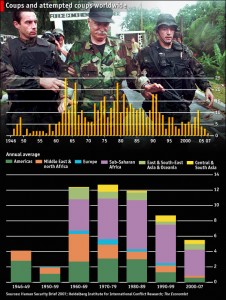
Old Fashioned Thinking for Old Fashioned Issues

A while ago, The Economist posted a Daily Chart (see below) about the frequency of coups, posing the question why are there less now then there were. I suspect they answer their own question while highlighting the limitations of too many political scientists and analysts. That is, The Economist (as well as the others I lump with it) is too concerned with the specific term (coup, here) and not with what it means. Why are coups themselves important? Usually, they are not. What is important, though, is that coups lead to regime change.

The question, therefore, should be not be why there are less coups but are there less regime changes? I suspect the answer would be no. The interesting question, therefore, is why has the method outside forces use for regime change evolved? And what does the evolution say? Given that regime change (successful or failed) now often takes place openly (e.g., Iraq, Afghanistan, Georgia, to some degree the Colored Revolutions), what does the new form mean about our international political behavior and norms?